
P Brockport’s Main Street Lift Bridge
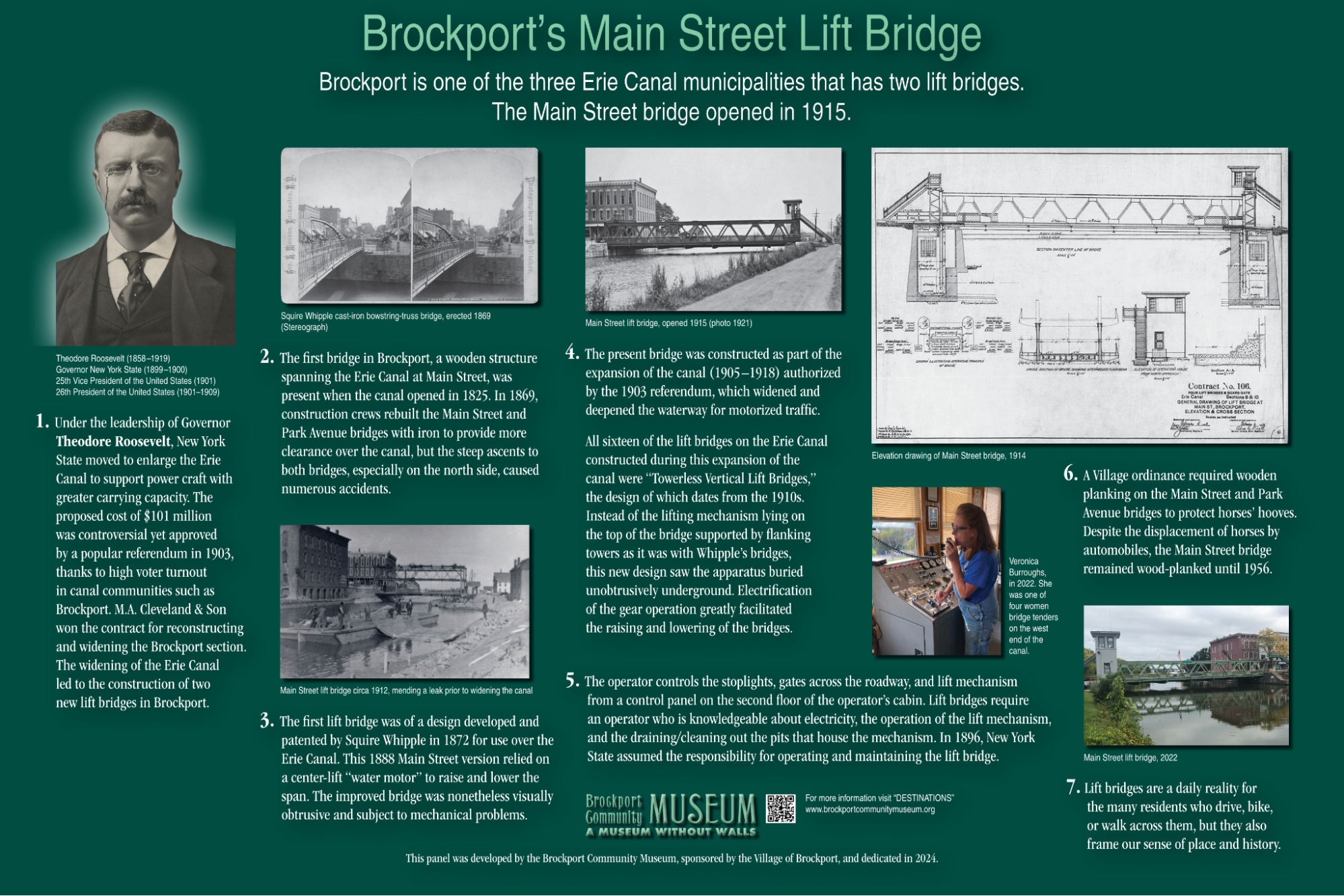
This panel, located on the west side of Main Street, just south of the bridge in front of the Post Office, commemorates the bridge that was constructed as part of the expansion of the canal (1905-1918) which widened and deepened the waterway for motorized traffic.
Under the leadership of Governor Theodore Roosevelt, New York State moved to enlarge the Erie Canal to support power craft with greater carrying capacity. The proposed cost of $101 million was controversial yet approved by a popular referendum in 1903, thanks to high voter turnout in canal communities such as Brockport.
M.A. Cleveland & Son won the contract for reconstructing and widening the Brockport section. The widening of the Erie Canal led to the construction of two new lift bridges in Brockport.
The present bridge was constructed in 1915. A village ordinance required wooden planking on the Brockport lift bridges to protect horses’ hooves and the Main Street lift bridge remained wood-planked until 1956.
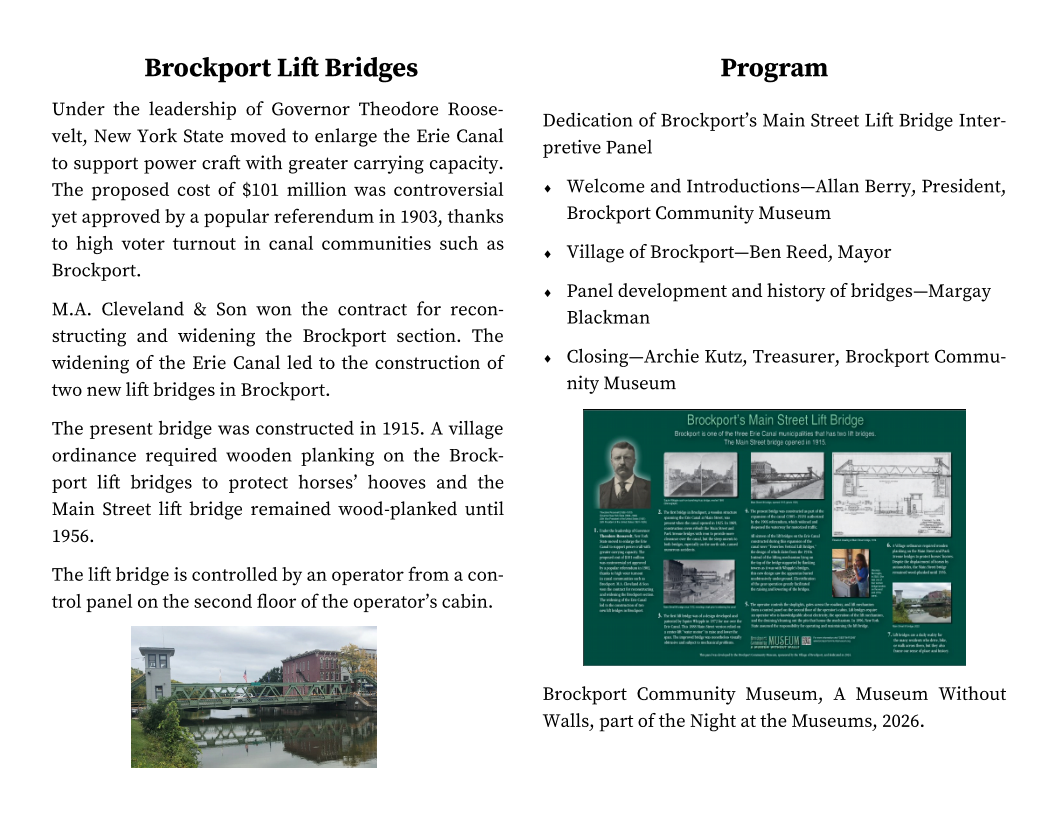
The lift bridge is controlled by an operator from a control panel on the second floor of the operator’s cabin.
The bridge recently underwent a major modernization project that closed it for two and one half years (5/2023-11/2025). Crews replaced over 80% of the structural steel, rebuilt the lift towers, installed a new metal bridge deck, and upgraded the mechanical and electronic operating systems. With all of the changes, it still looks like the original bridge that opened in 1915.
The panel was unveiled as part of the Night of the Museums 2026 held on May 30, 2026. Allan Berry, President Brockport Community Museum, welcomed everyone and Margay Blackman spoke about the development of the panel and history of bridges. Sandeep Singh, Village Trustee,spoke on behalf of Mayor Ben Reed who had a prior commitment.
Main Street Bridge Interpretive Panel Dedication 5/30/26. Comments by Margay Blackman
The current, refurbished, rebuilt Main St bridge is the third bridge in this spot over the Erie Canal. The first one was a bowstring Iron truss bridge that did not offer a lot of clearance below. Don’t know when it was installed but there are photos of it. The next bridge, designed by bridge engineer Squire Whipple (who also patented the iron truss bridge), is the one you see on the mural at the DPW building. The lifting mechanism was awkwardly on top of the bridge and the whole contraption was reminiscent of a Havaheart trap on Steroids. The current Main Street bridge, a lift bridge, was constructed as the canal was widened and deepened to become the barge canal and handle motorized traffic. Interestingly the 16 Erie canal liftbridges are all on the western end of the canal, Fairport to Lockport. Brockport is one of two canal communities that has two liftbridges. The other is Lockport, but one of theirs is now permanently in the up position, lacking the funds to repair it. [Albion has two—see notes from 2021] Interestingly there is no one designer of the Erie Canal lift bridges but it seems to have been a group of anonymous state employee draftsmen that designed them. This bridge opened to traffic in 1915, and was wooden planked until 1956. It closed once, in 1991 for 18 months for major repairs. Interestingly, when it reopened in 1992 a bridge engineer pronounced that it would not need a redo for 60 years.
I don’t know that anyone has made a prediction about the longevity of this version of the bridge redo, but it cost $18 million+ and virtually every piece of it, save the trusses, is new. —New, different and heavier counter weights, new larger sheaves to turn the cables that connect to the counter weights. Of course new decking. New concrete in the pits below the bridge. New safety measures in the lifting mechanism which required new training for operators. The bridge closed for repairs on May 15, 2023. Multiple delays in rescheduling the opening date of the bridge.
In hindsight one of the more amusing activities connected with the Main Street bridge repair was an attempt by a citizen committee, which called itself Bridging Brockport, to turn a long term engineering project into a learning experience that would engage high school/college students, the general public, downtown businesses. We had a webcam installed on the front of Custom House so the public could watch what was happening. This was courtesy of a computer business located on the north side of the canal that is no longer in Brockport due to the lengthy bridge closure. As mayor, I attended the biweekly engineers meetings to learn what was going on and posted weekly news items with photos on the village FB page and app detailing the progress of the project.
Eventually, everyone—residents, business owners, visitors, the Village Board tired of the lengthy delays. The bridge repairs/upgrades passed into a new village government administration. But eventually, the bridge reopened, in November of 2025, too late in the year to hold a dedication of the interpretive panel. We dedicated the companion panel, on the Park Avenue bridge, in June of 2023 as part of the Village of Brockport’s bicentennial. The panels were funded by an Erie Canal Impact Grant. I’ll close by repeating what I said at the dedication of the Park Ave bridge, “May these interpretive panels create interest and appreciation throughout our community for our unique and iconic lift bridges.”
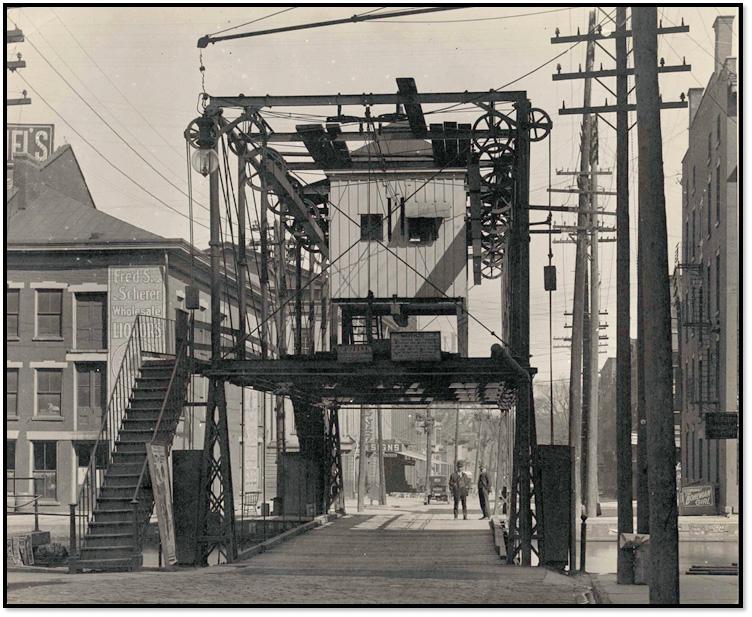
Picture Caption: Hotel Street Lift Bridge on the Erie Canal (1873), Utica, New York. Engineers began to build iron lift bridges on the Erie Canal after the Civil War. These builders included Squire Whipple (1804-1888), known as the father of iron bridge building. Pictured here is the lift bridge over the Canal on Hotel Street in Utica, constructed by Whipple in 1873. In this early design, the drive machinery was centrally located on the lift span over the roadway. Counter weights and wire ropes attached at the four corners of the span. As you can see, this early design was visually obtrusive, and a new generation of engineers designed the much cleaner lines of towerless bridges without centrally located drive machinery. The bridges in Brockport pioneered this innovative alternative in the early twentieth century.
Interpretive Panel Text
Brockport’s Main Street Lift Bridge
Brockport is one of the three Erie Canal municipalities that has two lift bridges.
The Main Street bridge opened in 1915.
- Under the leadership of Governor Theodore Roosevelt, New York State moved to enlarge the Erie Canal to support power craft with greater carrying capacity. The proposed cost of $101 million was controversial yet approved by a popular referendum in 1903, thanks to high voter turnout in canal communities such as Brockport. M.A. Cleveland & Son won the contract for reconstructing and widening the Brockport section. The widening of the Erie Canal led to the construction of two new lift bridges in Brockport.
- The first bridge in Brockport, a wooden structure spanning the Erie Canal at Main Street, was present when the canal opened in 1825. In 1869, construction crews rebuilt the Main Street and Park Avenue bridges with iron to provide more clearance over the canal, but the steep ascents to both bridges, especially on the north side, caused numerous accidents.
- The first lift bridge was of a design developed and patented by Squire Whipple in 1872 for use over the Erie Canal. This 1888 Main Street version relied on a center-lift “water motor” to raise and lower the span. The improved bridge was nonetheless visually obtrusive and subject to mechanical problems.
- The present bridge was constructed as part of the expansion of the canal (1905-1918) authorized by the 1903 referendum, which widened and deepened the waterway for motorized traffic.
All sixteen of the lift bridges on the Erie Canal constructed during this expansion of the canal were “Towerless Vertical Lift Bridges,” the design of which dates from the 1910s. Instead of the lifting mechanism lying on the top of the bridge supported by flanking towers as it was with Whipple’s bridges, this new design saw the apparatus buried unobtrusively underground. Electrification of the gear operation greatly facilitated the raising and lowering of the bridges.
- The operator controls the stoplights, gates across the roadway, and lift mechanism from a control panel on the second floor of the operator’s cabin. Lift bridges require an operator who is knowledgeable about electricity, the operation of the lift mechanism, and the draining/cleaning out the pits that house the mechanism. In 1896, New York State assumed the responsibility for operating and maintaining the lift bridge.
- A Village ordinance required wooden planking on the Main Street and Park Avenue bridges to protect horses’ hooves. Despite the displacement of horses by automobiles, the Main Street bridge remained wood-planked until 1956.
- Lift bridges are a daily reality for the many residents who drive, bike, or walk across them, but they also frame our sense of place and history.
Picture captions:
Theodore Roosevelt (1858-1919)
Governor New York State (1899-1900)
25th Vice President of the United States (1901)
26th President of the United States (1901-1909)
Squire Whipple cast-iron bowstring-truss bridge, erected 1869 (Stereograph)
Main Street lift bridge circa 1912, mending a leak prior to widening the canal
Main Street lift bridge, opened 1915 (photo 1921)
Elevation drawing of Main Street bridge, 1914
Veronica Burroughs, in 2022. She was one of four women bridge tenders on the west end of the canal.
Main Street lift bridge, 2022
Brockport Community Museum
A Museum Without Walls
This panel was developed by the Brockport Community Museum, sponsored by the Village of Brockport, and dedicated in 2024. (2026 due to the delay in reopening the bridge)
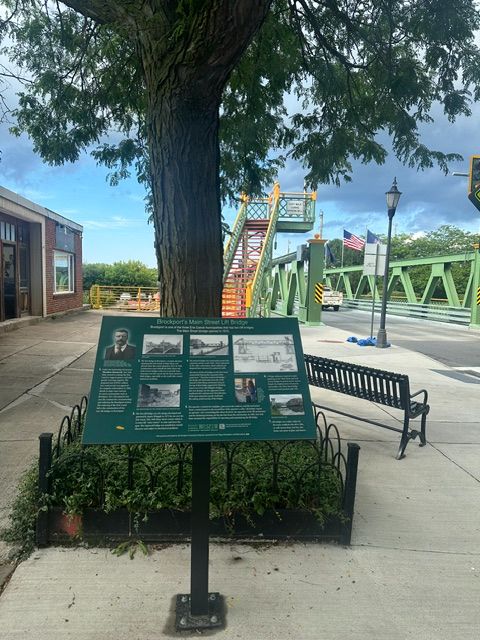
View facing north. Brockport’s Main Street Lift Bridge
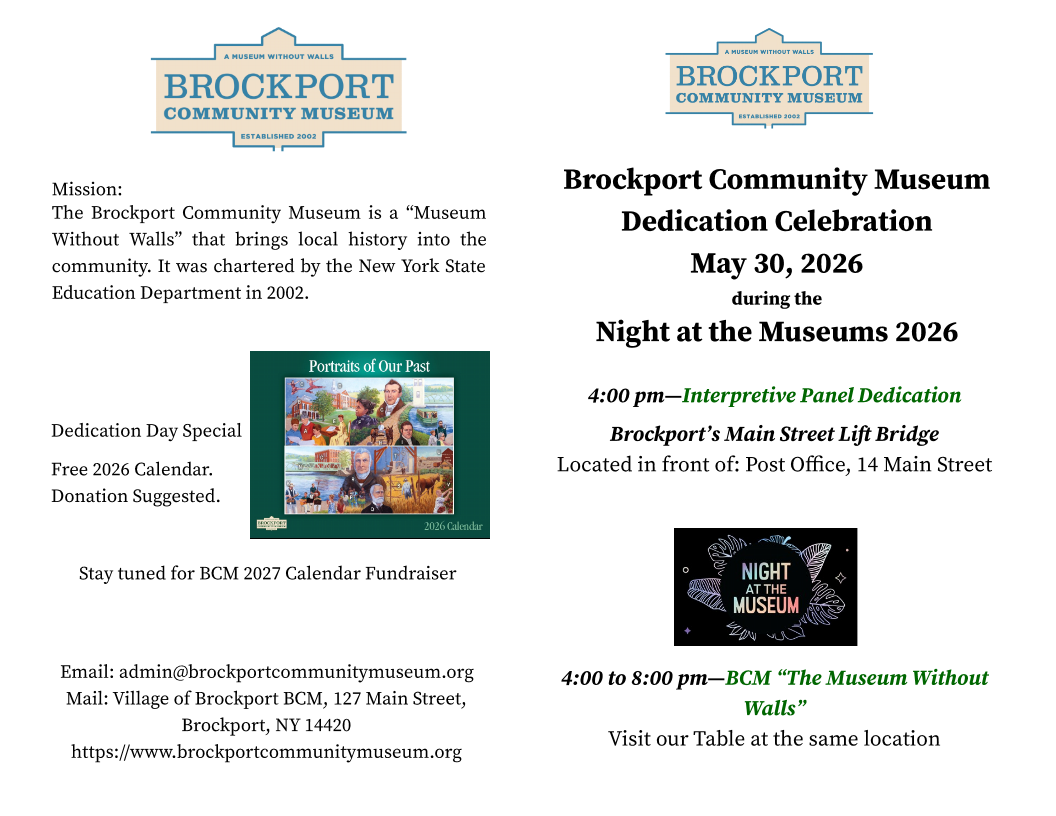
The program to the dedication
The program to the dedication