
Preserving the Stories of Our Community
The Brockport Community Museum is a “Museum without Walls” that brings local history to the people, rather than relying on the people to come to it. By memorializing this history in prominent sites throughout the village and by means of this website, the Museum makes its presence very evident and brings Brockport’s history forcefully into the lives of its residents.
Please select a category below:
2026 Calendar
2026-2027 Calendar
|
June 1, 2026 Monday – 5:00 |
Board Meeting Seymour Library |
|
July
|
|
|
August
|
|
|
September 4, 2026 Friday – 11:00 |
Executive Committee The Berry Patch |
|
October
|
|
|
November 6, 2026 Friday – 11:00 |
Executive Committee Meeting The Berry Patch |
|
December 9, 2026 Wednesday – 5:00 |
Board Meeting and Holiday Gathering The Berry Patch |
|
January 8, 2027 Friday – 11:00 |
Executive Committee Meeting The Berry Patch |
|
February
|
|
|
March 5, 2027 Friday – 11:00 |
Executive Committee Meeting The Berry Patch |
|
April
|
|
|
May 7, 2027 Friday – 11:00 |
Executive Committee Meeting The Berry Patch |
|
June 4, 2027 Friday – 5:00 |
Board Meeting Seymour Library |
|
July 9, 2027 Friday -11:00 |
Executive Committee Meeting The Berry Patch |
|
August 4, 2027 Wednesday – 5:00 |
Board Meeting and Annual Picnic TBD |
The BCM meets according to the adopted calendar. All meetings are open to the public. For more information please contact us.
Agendas and Minutes
Agendas and Minutes
History
History
The origins of the Brockport Community Museum lie in the administration of Brockport Mayor Mary Ann Thorpe. In 1998, the Village Trustees commissioned a Canalfront Master Plan by Larson Engineers. The plan included conversion of the large stone and frame structure at 60 Clinton Street from an auto repair shop into a small hotel or bed-and-breakfast. With a grant from the Certified Local Government (CLG) program, an architectural feasibility study was done for the Historic Preservation Board by Yarrington Architects in 2001.
That study produced conceptual plans for a small hotel, a bed-and-breakfast, and condominiums in that structure. Inquiries to possible commercial developers for the property elicited concern about the environmental, financial, and business feasibility for such a conversion. Therefore, the Historic Preservation Board obtained another CLG grant to have feasibility studies done on those issues. Before the studies were commissioned, however, Josephine Matela became Village Mayor. She believed that a museum in the 60 Clinton Street structure would be a more valuable asset for the village than a small hotel, a bed-and-breakfast, or condominiums. With the permission of the CLG program, the grant was used in 2002 to commission a feasibility study by John Bero Architects for the conversion of the structure into a museum.
The study estimated the cost of such a conversion at $2.7 million without including the installation of museum exhibits.
Meanwhile, a museum board of directors was formed and a provisional charter obtained from the State of New York, dated December 12, 2002. The Board adopted by-laws based on a model provided by the Chartering Office. Copies of the Charter and the By-Laws may be found elsewhere on this website. In November, 2002, the Greater Brockport Development Corporation (GBDC) was incorporated under New York State law. In order to qualify for 501(c)(3) status, the IRS required that it include an educational purpose in its mission statement.
Therefore, it revised its statement to include support of the Brockport Community Museum. As a result, the GBDC provides us with a banking account and was the channel for tax-deductible donations until we obtained our absolute charter and 501(c)(3) status in July 2010.
The village was awarded a $200,000 50/50 matching grant from the Environmental Protection Fund of New York State for the purpose of acquiring the structure and performing the exterior work needed to stabilize it. While the application was pending, the Village negotiated with the building’s owner for its purchase. However, the owner sold the building to a private businessman the day before the award of the grant was announced. The new owner expressed willingness to include museum space in the building as part of its redevelopment plans, but rejected a long-term lease arrangement for museum space in the building proposed by the Regional Director for the NYS Parks Department.
Also, while the application was pending, the Museum Board used two small grants from the Upstate History Alliance in June 2002 and June 2003 to engage Christopher Clarke, the immediate past president of the Landmark Society, as a consultant on museum development. Clarke estimated that the total cost of converting the building into a museum and installing museum exhibits would be $4 million and that it would cost at least $50,000 a year to operate, even if volunteer labor was used extensively. He recommended against pursuing that option. David Palmquist, director of the NYS museum chartering office, concurred.
In light of those recommendations, the daunting estimated cost of the conversion, and the difficulties and uncertainties of the negotiations with the new owner, the Museum Board adopted a “Museum without Walls” concept to develop the museum that currently includes four major components: Interpretive panels at public sites in the village, interior display cases in public venues throughout the village, this website, and “historical vignette” displays in shop windows in the historic district.
Although the “Museum without Walls” concept was adopted largely as a result of the inability to acquire and convert the Clinton Street building, it has two distinct advantages over a bricks-and-mortar approach. First, it is significantly less expensive. Second, it enables the museum to go to the people, rather than relying on the people to come to it. By placing historic materials in prominent sites throughout the village, the museum makes its presence very evident and brings Brockport’s history forcefully into the lives of its residents.
The BCM has a close, collaborative relationship with the Emily L. Knapp Museum of the Village of Brockport, now called the Brockport Museum & Library of Local History. Several members of its Board are also members of the Village’s Museum Committee, including its chair. Some BCM exhibits include artifacts on loan from the Knapp Museum.
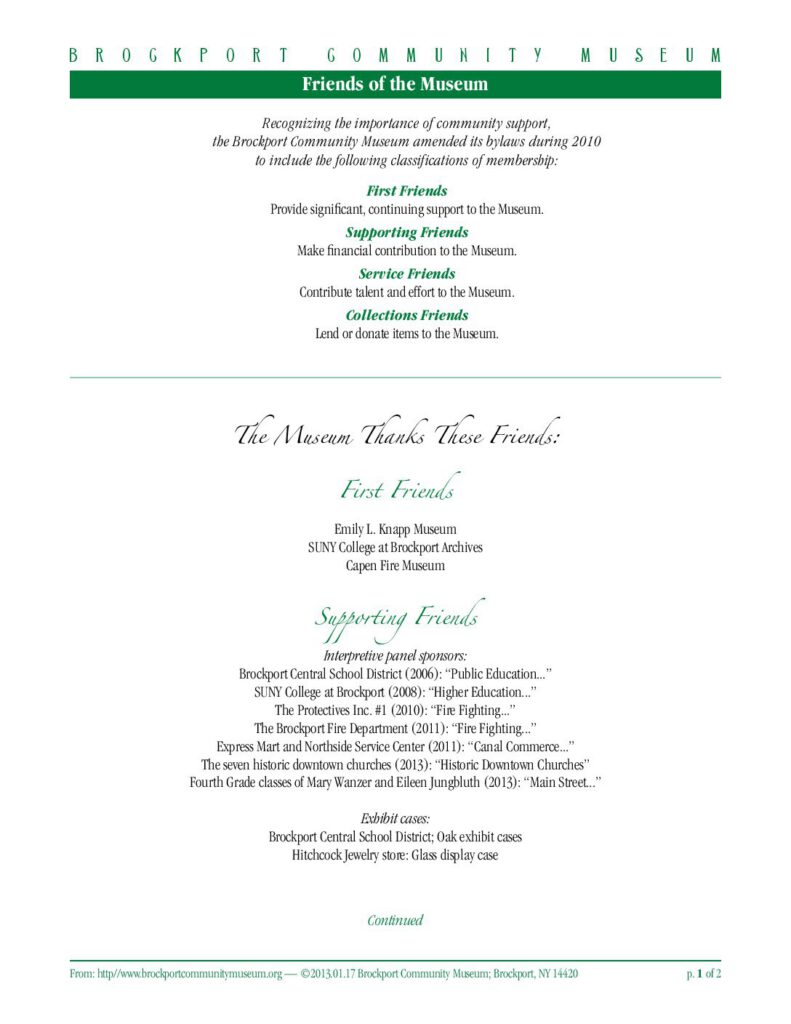
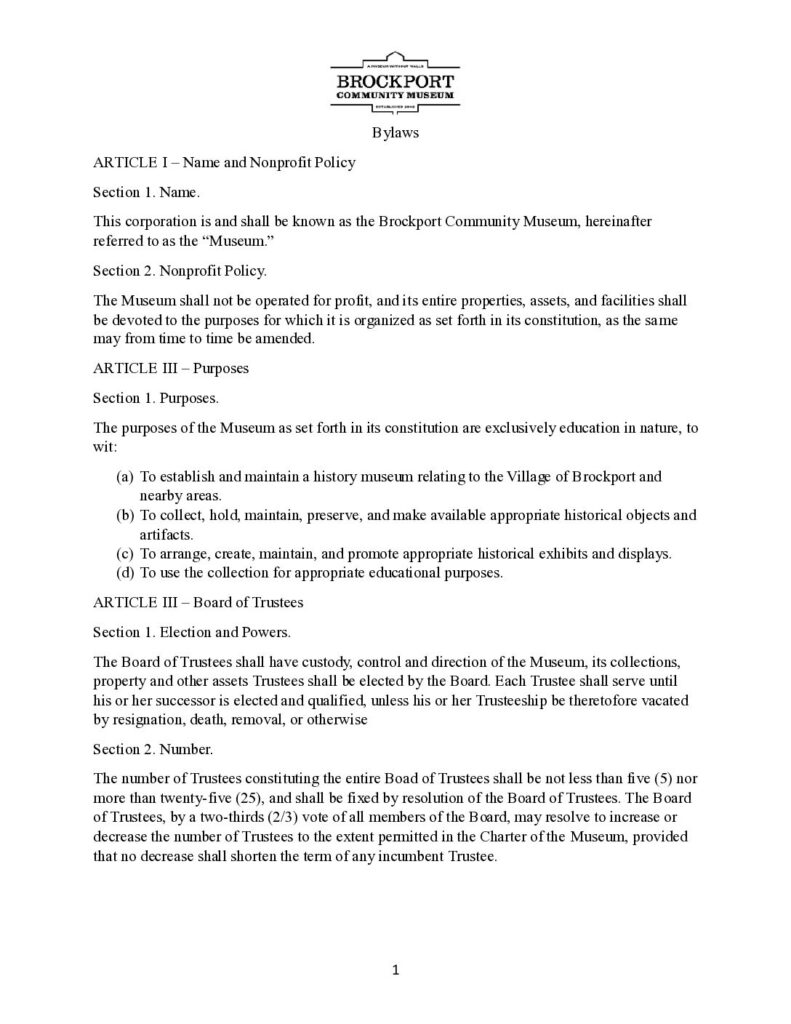
In 2010, the BCM received their absolute charter from the New York State Board of Regents, and their 501(c)(3) tax exempt status from the Federal Internal Revenue Service. The Board revised its by-laws to establish a “Friends” of the Museum organization. —William G. Andrews
Friends of the Museum
Friends of the Museum were a classification in the bylaws in 2010 that has now been changed to membership. We don’t want to lose the record of these friends so we are including the list here.

Bylaws
Bylaws
Board Members
BCM Board of Trustees
Bill Andrews
Allan Berry, President*
Rozenn Bailleul-LeSuer, Secretary*
Brian Davies
Ben DiMatteo
Jim Fallon, Vice President*
Kathy Goetz
Christine Hunt
Archie Kutz, Treasurer*
Bruce Leslie
Patrick Pittman
Alex Smith
Karen Sweeting
Robert Westbrook, At Large Member*
George Dahl**
Norm Frisch**
Garrett Roe**
*Executive Committee
**Honorary Trustees
This is current as of June 2026.
Committees
Active Committees
Executive:
This committee, chaired by the President, is established by the Constitution and Bylaws consists of the President, Vice-President, Secretary, Treasurer and an “at large” member to be elected at the annual meeting of the Board of Trustees. The committee exists for the purpose of exercising all the authority of the Board of Trustees between regular meetings of the Board and is required to report its actions to the Board of Trustees.
As of June 2026
Allan R. Berry, President
James C. Fallon, Vice President
Rozenn Bailleul-LeSuer, Secretary
Archie Kutz, Treasurer
Robert Westbrook, At Large
Community Relations:
This committee is responsible for recommending policies and activities that promote the work of the Museum using traditional and social media.
Ben DiMatteo
Finance:
This committee, chaired by the Treasurer, is responsible for recommending policies and activities that deal with the care and custody of all assets of the Museum.
Archie Kutz, Treasurer
Allan Berry
Nominating:
This committee is responsible for recommending policies, activities and membership on the Board of Trustees.
James C. Fallon, Chair
Interior Display:
This committee acquires exhibit cases, develops themes and borrows content. It also locates exhibits throughout the community and rotates contents on a periodic basis.
Archie Kutz
Bill Andrews
Bruce Leslie
Ben DiMatteo
Exterior Display:
This committee designs historic markers and interpretive panels, each on a specific topic, for outdoor placement in the community. It also secures funding for them.
Allan R. Berry, Chair
Jim Fallon
Allan Berry
Robert Westbrook
Bill Andrews
Website:
This committee archives Museum governance documents online, showcases Museum projects located in the community, develops documents about local history, and encourages assistance and feedback from community members.
Allan Berry
Archie Kutz
Ben DiMatteo
Robert Westbrook
Rozen Bailleul-LeSeur
Marleen Cain
Help Us
Help Us
Why donate?
Make local history accessible to the community with no admission fee..
Some Ways to Participate
- Find and preserve historic materials and/or memories not yet publicly available, before they are lost.
- Interview groups, individuals and families; record memories, images and artifacts.
- Identify various audiences and uses: Genealogy; Curriculum; Tourism, etc.
- Take part in Museum projects and activities.
- Encourage response to Museum projects through email, blogs, etc.
- Work with existing and emerging local history organizations (Museums, Libraries, Archives, Societies) such as the Brockport Museum and Library of Local History, Capen Fire Museum, Morgan-Manning House Museum, Seymour Library, SUNY Brockport Archives, Sweden Farmers Museum, Triangle Tract Historical Society, and others.
- Consolidate existing content from various sources into single focus topics for use in projects such as Interpretive Panels, Exhibit Cases, and the Web Site.
- Utilize traditional and social media to continually increase the visibility of the Museum, its members, constituents and projects.
Financial
We can only accept cash or check donations at this time.
Brockport Community Museum is a recognized 501(c)(3) not-for-profit corporation. Donations may be tax-deductible as allowed by law.
Private and corporate donations are welcome and greatly appreciated.
Questions
For general questions, please use the subject line “Help Us” and contact us by email.