
Civil War Exhibit Case
Currently located at the Drake Memorial Library, main reading room.
Some Brockport Area Civil War Heroes
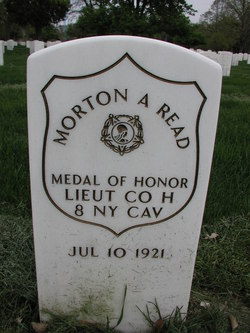
Morton A. Read
The Medal of Honor, the highest military decoration awarded by the United States government, is bestowed on a member of the United States armed forces who distinguishes himself “… conspicuously by gallantry and intrepidity at the risk of his life above and beyond the call of duty while engaged in an action against an enemy of the United States…” Morton A. Read was a Brockport printer who served as 1st Lieutenant of Co. D, 8th New York Cavalry. He was awarded the Medal of Honor for action on April 8, 1865, at Appomattox Station, Virginia. His citation reads “Capture of flag of 1st Texas Infantry (C.S.A.).” During the Civil War, regimental flags served as the rallying point for the unit, and guided the unit’s movements. Loss of the flag could greatly disrupt a unit, and could have a greater effect than the death of the commanding officer. Read’s grave is in the Danville Military Cemetery, Danville, Ill.
https://www.findagrave.com/memorial/8080820/morton_a-read
Five of the Plymouth escapees, including Cady (not identified individually)
Lester Cady
Brockporter A. Lester Cady enrolled October 5, 1861, at Hamlin as a 2nd Lieutenant in Co. B. Rocket Battalion. Rockets proved to be ineffective weapons and the regiment became the 24th Independent Battery, Light Artillery (Veteran). He was promoted to 1st Lieutenant, October 26, 1861, and to Captain, June 13, 1863. He was captured with his unit in action at Plymouth, NC, April 20, 1864, and imprisoned. He escaped with eleven others, October 5, 1864, made his way to northern soil, and returned to active duty, December 29, 1864. After his discharge, January 13, 1865, he returned home “so worn with hardship and privations that his wife at first failed to recognize him. From the effects of the journey he never fully recovered” and he died November 8, 1865. The Brockport area post of the Civil War veterans organization, the Grand Army of the Republic, was named in his honor.
Lewis B. Courtney
Brockport carpenter Lewis B. Courtney enlisted as a Private in Co. A., 140th New York Volunteer Infantry (the Brockport company), August 18, 1862, at age 29. He was promoted to Sergeant, February 28, 1863, to 2nd Lieutenant, February 1, 1864, to 1st Lieutenant, June 1, 1864, and to Captain, December 1, 1864. He was mustered out June 3, 1865. The citation for his battlefield promotion to Captain read: “for gallant and meritorious services at the battles of the Wilderness and of the Weldon Railroad” and was dated March 13, 1865.
William H. Joslyn
Brockporter William H. Joslyn enlisted as an Orderly Sergeant in Co. K, 13th New York Volunteer Infantry, April 26, 1861, at age 25. He was captured at the first Battle of Bull Run and imprisoned by the Confederates. He was paroled on December 3, 1862, and appointed 1st Lieutenant, Co. H, 21st New York Cavalry, October 14, 1863. He participated in all the battles of the Shenandoah Valley and served as provost marshal on the brigade staff through the fatal Lynchburg raid, when 1,500 horses died from hunger in the mountains in one day. He was promoted to captain “for brave and meritorious service”, May 12, 1865, and was honorably discharged October 5, 1865.
Thomas S. Hinton
Hamlin butcher Thomas S. Hinton enlisted as a Private in Co. M, 3d New York Cavalry, September 10, 1862, at age 21. He transferred to the 2d United States Colored Cavalry, April 7, 1864, with the rank of 2nd Lieutenant. “During a fierce fight [he] found himself at the side of Colonel N[athan P.] Pond [a Brockporter]. A Confederate made a saber stroke at the Colonel, which he dodged, receiving the blow on his leg. Before he could strike again Lieutenant Hinton drew his revolver and shot the enemy through the heart, killing him instantly.”—Brockport Republic, 3/12/08, obituary.
Jarvis Ring
Jarvis Ring, a resident of Adams Basin and student at the Brockport Collegiate Institute in 1845 and 1846, enlisted as a Private in Co. D (later Co. K), 13th New York Volunteer Infantry, May 14, 1861, at age 35. He was promoted to Sergeant, no date recorded, and to 2d Lieutenant, Co. B, June 12, 1863. “He was in the first battle of Bull Run. Later his regiment was sent to Newbern, NC, and took part in many battles and raids, one of which was the famous Tarboro raid [which] lasted six days and five nights during which time the men were continuously in the saddle. He was twice promoted for bravery on the field of battle and publicly commended….[H]e was honorably discharged on account of disability [June 10, 1864]”— Brockport Republic, 9/6/06 obituary. In 1880, he was a cooper, living in Clarkson with four daughters and a son.
Stephen R. Stafford
Stephen R. Stafford, a resident of College Street, private, Co. G, 13th NYVI, and Co. K, 3rd NY Cavalry, May 9-Sept. 18, 1861; 2nd Lt. Co. I, 129th Infantry that became 8th Heavy Artillery, August 7, 1862; 1st Lt. January 27, 1864; Capt. November 5, 1864; mustered out with company June 5, 1865. Promoted Major by brevet, for faithful and meritorious services during the war, March 1, 1865. Phisterer 424. Such promotions were conferred “upon such officers…as have or may distinguish themselves by gallantry in battle or meritorious and honorable conduct, which mark of honor shall be stated in the commission conferred.” He fought at Bull Run, Antietam, Gettysburg, the Wilderness, Spottsylvania, North Anna, Cold Harbor, Hatcher’s Run, Deep Water, Reams Station, and Petersburg. He was wounded at North Anna and led “a desperate charge at Hatcher’s Run, for which General Gibbon…tendered him high praise and honor in the presence of the entire command.” From May 27, 1867 until he retired July 1, 1898, he was an officer in the regular army, retiring with the rank of major. He died May 31, 1902. BR 12/11/02.
Benjamin Chedell Efner
Benjamin Chedell Efner, age 34 in 1862, enrolled as a private in the 8th New York Cavalry, August 29, 1862, was promoted to 2nd Lieutenant, October 14, and had been commissioned a captain commanding Company I, a few days before the Battle of Beverly Ford, Va., June 9, 1863, where he “rode some distance in advance” of his unit, “and was quite alone. A rebel fired upon him from a heap of logs and brush in which he had concealed himself—the ball entered Captain Efner’s thigh and passing upward went into his stomach. He fell from his horse and the rebel sprang from his cover and mounted the animal to escape. Capt. Efner drew a pistol, fired, and shot the rebel dead from the horse and the animal galloped away riderless.” Efner died at an army hospital in Georgetown, D. C., on June 12. In that battle, his regiment lost three officers and nine enlisted men killed, two officers and one enlisted man died of wounds, 28 enlisted men wounded but recovered and seven enlisted men were missing.
This print of a painting by John William Wagner depicts a crucial moment in the Civil War. The 140th New York Volunteer Infantry regiment, led by Brockport’s Company A, is charging down the south side of Little Round Top, a strategic height above the Gettysburg battlefield on the second day of the battle, July 2, 1863. The regiment had been diverted from its march toward an assigned position, because a Texas regiment had been seen marching toward the summit to seize the hill for the Confederates. The New Yorkers plunged into battle so hurriedly that the first ranks had not loaded their rifles or fixed their bayonets. The Texans were so startled by the sudden appearance of the Yankees that they fell back and, after a pitched battle, yielded the field, leaving the Union in possession of a site that controlled the battlefield during the next day’s decisive combat. The Battle of Gettysburg was the high point of the Confederacy and the beginning of its end. The painting is titled “Down this Way, Boys”, words that the regimental commander, Colonel Patrick O’Rorke, shouted to begin the charge. He is shown, waving his sword, moments before he was shot dead. First Lieutenant Porter Farley is at the right end of the first rank. All the other soldiers are members of Company A, including its commander, Captain Milo Starks of the Town of Sweden, in the lower right corner, drawing his sword, and Sergeant-Major J. R. Campbell, behind him.
In no particular order: 1st Lieut Isaiah Conley – 101st PA, Capt Thomas B. Dawson – 101st PA, 1st Lieut William C. Davidson – 101st PA, Capt A. Lester Cady – 24th NY Battery, and Lt Masters of the 2nd NC.
Phisterer 1613—CADY, A. LESTER, age 25 years; enrolled October 5, 1861, at Hamlin to serve three years; mustered in as Second Lieutenant, Company B, Rocket Battalion (subsequently 24th Independent Battery, Light Artillery (Veteran)), October 26, 1861; as First Lieutenant, to date October 26, 1861; as Captain, to date June 13, 1863; captured in action at Plymouth, N.C., April 20, 1864; escaped from Columbia, S.C., October 5, 1864; reported at Camp Parole, Md., December 29, 1864; discharged, to date January 13, 1865…. BR 9/16/09—The 24th Independent Battery was formed by Captain Cady from Volunteers whom he gathered together in and about Brockport, where he lived when the war broke out. At the battle of Plymouth, NC, in 1864, he was stunned by the discharge of a cannon and picked up for dead. Later he regained consciousness and was taken prisoner by the Confederates. Captain Cady was confined at Plymouth for a time, and then it was decided to transfer him, along with other captives to the prison at Andersonville. As soon as the prisoners heard of the plans that were on foot they determined to take advantage of the favorable opportunity which the transfer would offer to made a dash for freedom. Accordingly one dark night Captain Cady and eleven others slipped from the moving train and struck out for the North. After narrowly escaping recapture on several occasions the party made its way through the mountains and eventually reached Northern soil. When Captain Cady arrived at his home in Brockport he was so worn with hardship and privations that his wife at first failed to recognize him. From the effects of the journey he never fully recovered….and about a year later he died.[Nov. 8, 1865]
= Joslyn, William H., sergeant [later 1st Lt/Capt, Co. H 21st NY Cavalry], age 25. BR 9/23/09—On April 26, 1861, he enlisted in co. K, 13th NYVI, in which he became orderly sergeant. He was captured at the first battle of Bull Run, and was confined in Libby Prison, (old Parish prison) and in New Orleans and Salisbury prison, NC. He was paroled on Dec. 3, 1862. On Oct. 14, 1863, he was again mustered into service as first lieutenant of Co. H, of the 21st NY Cavalry. He participated in all the battles of the Shenandoah Valley and served as provost marshal on the brigade staff through the fatal Lynchburg raid, when 1,500 horses died from hunger in the mountains in one day. On May 12, 1865, he was promoted to captain for brave and meritorious service. He was honorably discharged Oct. 5, 1865. Phisterer 1061—age 27 years; enrolled at Troy to serve three years, and mustered in as First Lieutenant, Company H, October 14, 1863; wounded in action July 17, 1864; mustered in as Captain, May 12, 1865; mustered out, October 5, 1865, at Denver, Col….
#+Hinton, Thomas S., of Hamlin, lieutenant to captain=, bugler; Phisterer 4186—age 21 years; enrolled August 11, 1861, at Brockport to serve three years; mustered in as Private Company M, 3d NY Cavalry, September 10, 1862; mustered out for promotion to Second Lieutenant, 2d US Colored Cavalry, April 7, 1864; mustered out as such, May 11, 1865. BR 3/12/08—[D]uring a fierce fight [H.] found himself at the side of Colonel [N.P.] Pond. A Confederate made a saber stroke at the Colonel, which he dodged, receiving the blow on his leg. Before he could strike again Lieutenant Hinton drew his revolver and shot the enemy through the heart, killing him instantly.
Ring, Jarvis, of Adams Basin and BCI, Lieutenant, 13th NY Vol. Inf./Co. K 3rd NY Cavalry [of Clarkson in 1888] BR 9/6/06—Lieut. Jarvis Wm. Ring…went out in the “Old Thirteenth” regiment but was afterwards transferred to Co. K, third NY Volunteer Cavalry. He was in the first battle of Bull Run. Later his regiment was sent to Newbern, NC, and took part in many battles and raids, one of which was the famous Tarboro raid. This raid lasted six days and five nights during which time the men were continuously in the saddle. He was twice promoted for bravery on the field of battle and publicly commended. After serving for three months he was honorably discharged on account of disability. [Died 9/4/06] Phisterer 799—age 35 years; enrolled at Elmira to serve two years, and mustered in May 14, 1861, as Private, Company D, 13th Infantry, which became, September 1, 1861, Co. K, this regiment, promoted Sergeant, no date; supernumerary Second Lieutenant, on date (probably November or December, 1862); mustered out, May 3, 1863; mustered in as Second Lieutenant, Co. B, to date June 12, 1863; resigned, June 10, 1864…
Courtney, Lewis B., Phisterer 379 Roll of Honor–First Lieutenant, 140th Infantry; Captain by brevet, for gallant and meritorious services at the battles of the Wilderness and of the Weldon Railroad, to date from march 13, 1865; p3622—age 29 years; enrolled August 18, 1862, at Brockport to serve three years; mustered in as Private, Co> A, September 13, 1862; promoted Sergeant, February 28, 1863; mustered in as Second Lieutenant, Co. D, February 1, 1864; as First Lieutenant, Company A, June 1, 1864; as Captain, December 1, 1864; mustered out with company, June 3, 1865, near Alexandria, Va.; BR 8/28/62—Married Ellen F. Lossee, of Alabama Center, Genesee County, 8/14/62.
In 1931, all cemeteries were required by New York State to complete a form, listing all “soldiers, sailors and marines” who were buried there. This is the form submitted for the Beach Ridge cemetery in the Town of Sweden, now adjacent to the Lake View cemetery. Except for two veterans of the Revolutionary War and two from World War I and three who are not associated with a war, all were soldiers in the Union Army. Milo Starks (name misspelled) is the seventh name from the bottom.
After the war, the New York State Department of Military and Naval Affairs required all town clerks to complete lengthy double-page forms reporting their towns’ contributions to the Union cause. This is page 11 of the February 9, 1866, report for the Town of Sweden. The information on Milo Starks is the bottom entry on the page.
Nine companies were recruited for the Union Army in the village. The first of them was Company K of the 13th New York Volunteer Infantry. This was the first regiment formed in Monroe County, in response to President Lincoln’s first call for volunteers on April 18, 1861. Brockport and Rochester were the only municipalities to form companies in that regiment. By April 25, 75 men had signed up for company K. By May 14, they numbered 85, 37 from Brockport, 10 from Sweden, 12 from Clarkson, 11 from Hamlin, and 15 scattered among other municipalities. The other “Brockport companies” were Company. G (or F?) of the 105th, Company C (or H?) of the 108th, and Companies A and H of the 140th New York Volunteer Infantry regiments and Company M of the 3rd, Companies H and K of the 8th, and Company C of the 22nd New York Cavalry regiments.
In the three towns, the casualty rates for the number of men who died from war-related causes or suffered non-fatal wounds was Sweden 22.5 percent, Clarkson 31.3 percent, and Hamlin 29.8 percent. If men discharged for service-related “disabilities” (which may have included wounds) are added, the figures are Sweden 31.8 percent, Clarkson 41.1 percent, and Hamlin 34.3 percent. If the figures for the three towns are aggregated, exactly one-third (33.3%) of the men who served in the Union army from the Brockport area died in the service, were wounded or otherwise disabled. The breakdown was:
| Died | Wounded | Disabled | Served | |
| Sweden | 35 | 18 | 22 | 236 |
| Clarkson | 19 | 9 | 9 | 90 |
| Hamlin | 42 | 30 | 11 | 242 |
In August 1864, a town meeting authorized the Town Board to pay bounties to 96 men in amounts ranging from $10.00 to $600. The most common amount was $600 (71). There was one bounty of $10 and one of $200. The other 23 ranged between $400 and $575. The total was $54,125, to be raised by a special tax levy—this in a town that had an annual budget that averaged less than $1,250 during the war. This is a copy of the page from the Town Board Minutes reporting that action.
The Civil War service record of Edward H. Greenough, Company F, 140 New York Volunteer Infantry. Company A of the 140th was recruited in Brockport. The card lists the brigade assignments of the regiment and the service activities from being mustered in on September 13, 1862, to being mustered out on June 3, 1865 (On loan by Kermit Mercer).
An envelope sent from Brockport on November 26, 1863 to Captain Milo L. Starks, commander of Company A, 140th New York Volunteer Infantry, the Brockport company. Starks was a 26-year-old farm boy from the Town of Sweden, described by one of his comrades as “tall, dark, and with an intimidating appearance”. He was deeply religious, the son of a Baptist deacon. Starks led his company down Little Round Top on the second day at Gettysburg that is described elsewhere in this exhibit. In that engagement, he was wounded four times, but remained with his unit until the fighting ended. He was promoted to the rank of major in October 1863. He was killed by a Confederate bullet at the battle of Laurel Hill in May 1864, and buried, with full military honors, in Beach Ridge Cemetery, Section I, Lot 76.[Information from Brian A. Bennett, Sons of old Monroe.]
Milo Starks
Rochester Rifles was the nickname of the 13th New York Volunteer Infantry. Company K of that regiment was formed in Brockport. This ribbon was probably worn at a reunion of that unit or at a meeting or convention of Civil War veterans. Below are photographs of two Brockport members of Company K.
Left: Pvt. George H. Hill Co. K (Brockport), 13 NY Inf. Right: Pvt. Theodore H. Jameson Co. K (Brockport), 13 NY Inf. Hill became a sergeant and Jameson a corporal. Both photos courtesy of the US Army Military History Institute.
On Tuesday April 23, 1861, just eleven days after the firing upon Ft. Sumter, Charles Nelson walked into the recruiting station in Brockport and enlisted in Company K of the Thirteenth New York Infantry. Captain Thomas, his company commander, swore in Charles for two years of state service. The “Rochester Rifles” was then being formed in Rochester.
13th Regiment NY Volunteer Infantry
Regimental Color
80” hoist x 80” fly
In May 1861, the “ladies of Rochester” presented this custom-made regimental color to the 13th New York Volunteer Infantry. The flag features a stylized, painted version of the Arms of the State of New York with “ROCHESTER REGIMENT” painted above. Carried for two years and deposited with state authorities by Colonel Elisha Marshall, the flag includes three fabric layers. The outer layers are each made from a single piece of blue silk. Two pieces of plain cotton, seamed vertically, form the inner lining. Yellow painted bands line the flag’s top and bottom. Three separate pieces of metallic bullion fringe trim the top, fly, and bottom edges. In 1961, a flag restorer disassembled the flag and sandwiched each outer silk layer between blue, nylon net. The center cotton lining and staff sleeve, most likely original, are between the two layers of “netted” silk. The restorer then attached all the layers around the outside edges. (2005.0008)
These two carte de visite photos were taken of Civil War soldiers by W. H. Fuller, a Brockport photographer. The one on the left is inscribed on the back “Cdv taken from original tintype for family members of deceased soldiers. Cavalry hat!” The one on the right bears no inscription.
The inscription on this ribbon reads “THOMPSON CAMP No. 50 S. V. BROCKPORT, N.Y. compliments of JOSEPH MYERS. The S. V. stands for Sons of Veterans. This was an organization of the sons of Union Army soldiers. Several Thompsons served in companies recruited in Brockport. Two were brothers, Joseph, age 19, and Charles, age 24, from Hamlin, born in Canada, in the 13th New York Volunteer Infantry. A Brockporter named Joseph Myers served in Company D of the 22nd New York Cavalry. Probably, the ribbon was worn at a convention of the organization. Associations related to the Civil War played important roles in the social and political lives of American communities in the decades after 1865. The largest and most important of them was the Grand Army of the Republic, which had a chapter in Brockport that remained active until the early 1930s, more than 65 years after the end of the war. The veterans of many Civil War units held annual reunions for many years after the war. This ribbon was worn at a reunion of the 140th New York Volunteer Infantry, held in Brockport on Thursday, June 28, 1894. Company A of that regiment was formed in Brockport.
The nine Brockport companies were units in six regiments. Regimental flags for four of them have been restored by the NYS Department of Military and Naval Affairs and images of them have been placed on the department’s website. The 140th NYVI regiment had, successively, two flags. All five are shown here.
This print of a painting by John William Wagner depicts a crucial moment in the Civil War. The 140th New York Volunteer Infantry regiment, led by Brockport’s Company A is charging down the south side of Little Round Top, a strategic height above the Gettysburg battlefield on the second day of the battle, July 2, 1863. The regiment had been diverted from its march toward its assigned position, because a Texas regiment had been seen marching toward the summit, preparing to seize the hill for the Confederates. The New Yorkers plunged into battle so hurriedly that the first wave forgot to load their rifles or fix their bayonets. The Texans were so startled by the sudden appearance of the Yankees that they fell back and, after a pitched battle, yielded the field, leaving the Union in possession of a site that overlooked the next day’s decisive struggle and, in effect, controlled the battlefield. The Battle of Gettysburg was the high point of the Confederacy and the beginning of its end. The painting is titled “Down this Way, Boys”, the words that the regimental commander, Colonel Patrick O’Rorke, is said to have shouted to begin the charge. He is shown, waving his sword, moments before he was shot dead. Company A is immediately behind him. First Lieutenant Porter Farley is at the right end of the first rank. Captain Milo Starks of the Town of Sweden, commander of Company A, is in the lower right corner, drawing his sword. Brockporter Sergeant-Major J. R. Campbell is behind him.
This image shows the 140th New York Volunteer Infantry regiment, including Brockport’s Company A, at the Battle of Saunder’s Field on May 5, 1864, during the Wilderness campaign. Regimental commander Colonel George Ryan, waving his hat, leads the charge. First Lieutenant Porter Farley, wielding his sword, is on his right. The soldiers’ Zouave uniforms were issued in recognition of their military prowess. The charge failed and the New Yorkers fell back, after the 529 men suffered 255 casualties. This picture and a full account of the battle appear in Don Troiani’s Civil War, Stackpole Books, 1995, 188p, text by Brian C. Pohanka. The display in this case is presented by the Brockport Community Museum in commemoration of the heroic role the Brockport area community played in the American Civil War. Besides the nine military companies recruited in the village, Brockporters contributed importantly by collecting and shipping to the war front large amounts of relief supplies for the troops and by stretching their financial resources to provide recruitment bounties and commutation fees, as well as relief payments to the indigent families of soldiers. Additional information and images will be available on the website brockportcommunitymuseum.org by December 1, 2009. This will include articles on Brockport’s home front during the war and a history of the 13th New York Volunteer Infantry regiment, with its Brockport company, and portions of the wartime diary of Brockporter John T. Farnham.
Brockport Soldier and President Lincoln
John T. Farnham lived in Brockport and worked as a printer at the Brockport Republic weekly newspaper when the Civil War began. In August 1862, he enlisted in the 1st Regiment NYS Sharpshooters in Rochester. He wrote 57 letters that were published in the Republic during the war. He also kept a detailed diary throughout the war. In October 1863, he was stationed near Washington, D. C. His entry for the 12th reads, in part: “Strolled down Penn. Avenue, took another look at the White House, & happened to see Pres’t Lincoln & son standing on the stoop, — he looks sick & care-worn.” In April 1865, he was in Washington again. His diary reports that, on April 14, he went to see a play in Grover’s Theater. His entry for April 14 reads, in part, “A panic was caused…by the announcement that the President had been assassinated…(shot in the head) with the assassin escaping…a desperate tragedy, and the audience left Grover’s before the play ended. I went to Ford’s…. Mr. L. had been taken across street to private house, insensible. A crowd stood in waiting, in bad humor with rebels. Excited. At 11½ the crowds dispersed.” His entry for April 18 reports that he ran into, “Lieut. Genl. Grant, alone. He looked sad and I only recognized him by the three stars on his shoulders… [P]roceeded to White House where thousands were waiting to get in. Passed into East Room and viewed hastily and unsatisfactorily the face of Mr. Lincoln in his splendid coffin… The features looked rather painful and a white powder had been sprinkled on the face. A sad scene.” On May 18, he wrote that he “called on Miss Coleman who gave me as a relic of A. Lincoln a cuff cut from the shirt he wore when assassinated. I was glad to get the relic.” The cuff was blood-stained. The diary and the cuff sold at auction in November 2008 for $23,900. After the war, Farnham returned to Brockport, died in 1870, and is buried in Hamlin. This display shows his diary entry for April 14, the cuff, and the cover of his diary.
This copy of a Currier & Ives print depicts the first Battle of Malvern Hill during the Peninsular Campaign of June 1964. Brockport’s Companies H and K of the 8th NY Cavalry and Company C of the 22nd NY Cavalry regiments took part in this battle. The 8th suffered one enlisted man killed, seven wounded and recovered. And one man missing. The 22nd suffered one man missing. Brockport’s Company M of the 3rd NY Cavalry fought in the second Battle of Malvern Hill on August 1, 1864, and had one man wounded who recovered.
This copy of a Currier & Ives print depicts the Battle of Antietam on September 17, 1862, bloodiest one-day battle in American history. Brockport’s Company G of the 105th New York Volunteer Infantry and Company C of the 108th New York Volunteer Infantry took part in this conflict. The 105th lost two officers and fifteen enlisted men and another two officers and 46 enlisted men were wounded. The 108th lost two officers and forty enlisted men and two officers and 107 men were wounded but recovered.