
Federal Camps Historic Marker

Unveiled and dedicated October 25, 2025
Next to 968 Moscow Road, Hamlin, NY
The Civilian Conservation Corp (CCC) was a national program in the 1930s where young men worked to help their families and to help build national and state parks, among many other projects. They were housed in a camp in Hamlin and helped to turn a small county park into Hamlin Beach State Park. Once the camp closed, it became a WWII Prisoner of War Camp. Once that closed, the camp disappeared and was taken over by Mother Nature. Then Ed Evans and his volunteers unburied the site and they continue to work to preserve this historic treasure.
While this marker was made possible by the Town of Hamlin, the Brockport Community Museum, the NYS Department of Parks (HBSP), and the Hamlin Highway Department, it would truly not be possible without the dedication, teamwork, and sheer grit of Ed Evans and the volunteers who unburied the site and gave it new life.
Ed Evans and his volunteers spent many years unburying the camp and collecting artifacts and information. Ed wrote about this experience and about what he discovered about the CCC/POW camps and the people at the camps.
Special invited guests – Nick Kramer, Sue Evans, Jesse Evans, Marty Howden, Jay Bailey, David Walch, Mark Ballerstein, Sherry Dobson, Bunny Beardsley, Gary Leverenz, Ross Lovell, Patti Sullivan, Josh and Zach Vogt, Aiden Maxwell
Ed Evans speech at the marker dedication
Dedication of the CCC/POW Camp Historic Marker
10/25/25
Jennifer, thank you for inviting me. I was pleased you asked me to provide a list of people who I thought made contributions above and beyond to the unburying of the site so that you could send them personal invitations. Three Eagle Scouts have been added to the list – Josh and Zach Vogt and Aiden Maxwell. I’m glad to see that many of you on the list made it here on such short notice.
Gary Leverenz is on that list. He’s the nine-year-old boy who in 1945 peered into the POW camp one night from that bathroom window right over there, when he heard, somewhere back there, the only machine gun firing ever heard in this camp. Little Gary was excited and expected to see bodies being carried away in the morning and was disappointed when there weren’t any.
There are a few more people I wish could be here this morning but they are no longer with us. Of course, Mary Smith is on that list. Mary Smith started trying 40 years ago to get this sign here and I know she would be thrilled to see it finally happening. It was Mary who single handedly kept the memory of the camp alive until we could unbury it!
Jennifer, your father found our first shed to store our tools in and had it moved here. It’s that little white building back there. [Eagle Scout Josh Vogt dolled it up for us.] I’m sure your Dad would have applauded the unveiling of this sign.
And the late Dan Wilson. He missed seeing the sign go up by four years. Dan could have bought a new truck with all of the retirement money he spent here. He bought equipment, repaired all of our equipment, invented special tools, worked miracles of all kinds, and holds the record for the amount of brush and stumps he made disappear. Nick Kramer is the only one still trying to close in on Dan’s brush clearing record.
Not to be forgotten, are the two WWII German soldier pen pals I had who didn’t know each other but lived in this camp during the war. Heinrich Willert and Gottfried Schultz provided me with the only present day, live, first hand information about the POW camp that evolved from the CCC camp that stood over there. In fact, one of them was standing a short distance away from the machine gun that was firing the shots heard by nine-year-old Gary Leverenz. Pen pal Gottfried Schultz was able to clear up that 70-year-old mystery for us.
For a while I treated those two pen pals as separate sources until I eventually figured out that they lived in the same barracks, at the same time, and their bunks were 50 feet apart. They sure were surprised when I told them that! Then I found out that they were living 11 miles apart in Germany 70 years later and still didn’t know each other! With the help of their grandsons, they were introduced and the reunion was written up in a newspaper over there – a full page with photos. They hung out a lot after that and passed away in their 90s a few years ago. I know they would have loved to be part of this dedication.
This sign is going to draw people from all over to check out that huge “outdoor auditorium” sitting right over there. [That’s what I call it.] It is a one-of-a-kind historic site and it needs to be preserved. Many of the stories about how the country and this local community were able to survive the great depression and WWII that followed with most of the men away are not found in books or heard in classrooms. You’ll only hear those stories when you are guided around this site.
There were over 4,000 CCC camps in the US but most of them were in operation for less than a year. Letchworth for example had four CCC camps. Three were operating a little less than a year and one for about 14 months. Our camp was in full swing for a full six years! And our camp was one of the few in the country to then be turned into one of the 377 German POW camps in the US during the war. Twice it housed over 450 POWs who helped our community survive the war. There may be a CCC camp or two fully restored somewhere in the country but I’ll bet you neither of them was also a POW camp.
Furthermore, most of the other CCC camp sites in the country have been built over, have roads and parking lots sitting on them, have been turned into farm land, or have been crowded out by housing developments. Every square inch of our site is just as it was in the 1930s and 1940s with artifacts still buried in the ground. It took years to remove nature’s protective cover over it but the view around it is almost exactly as it was. The roads coming to it and from it are the same roads. The neighbor’s house and barn to the east are still there. The house and barn that were across the street are still there. And the house some German POWs liked to paint pictures of is still sitting over there waiting to be turned into a museum and research center. If there is ever going to be a Genesee Country Village type attraction ever built recreating a CCC and a POW camp, this has got to be the perfect place to build it! The Park already owns the land.
With the help of this new sign, some of you might live long enough to see that happen!
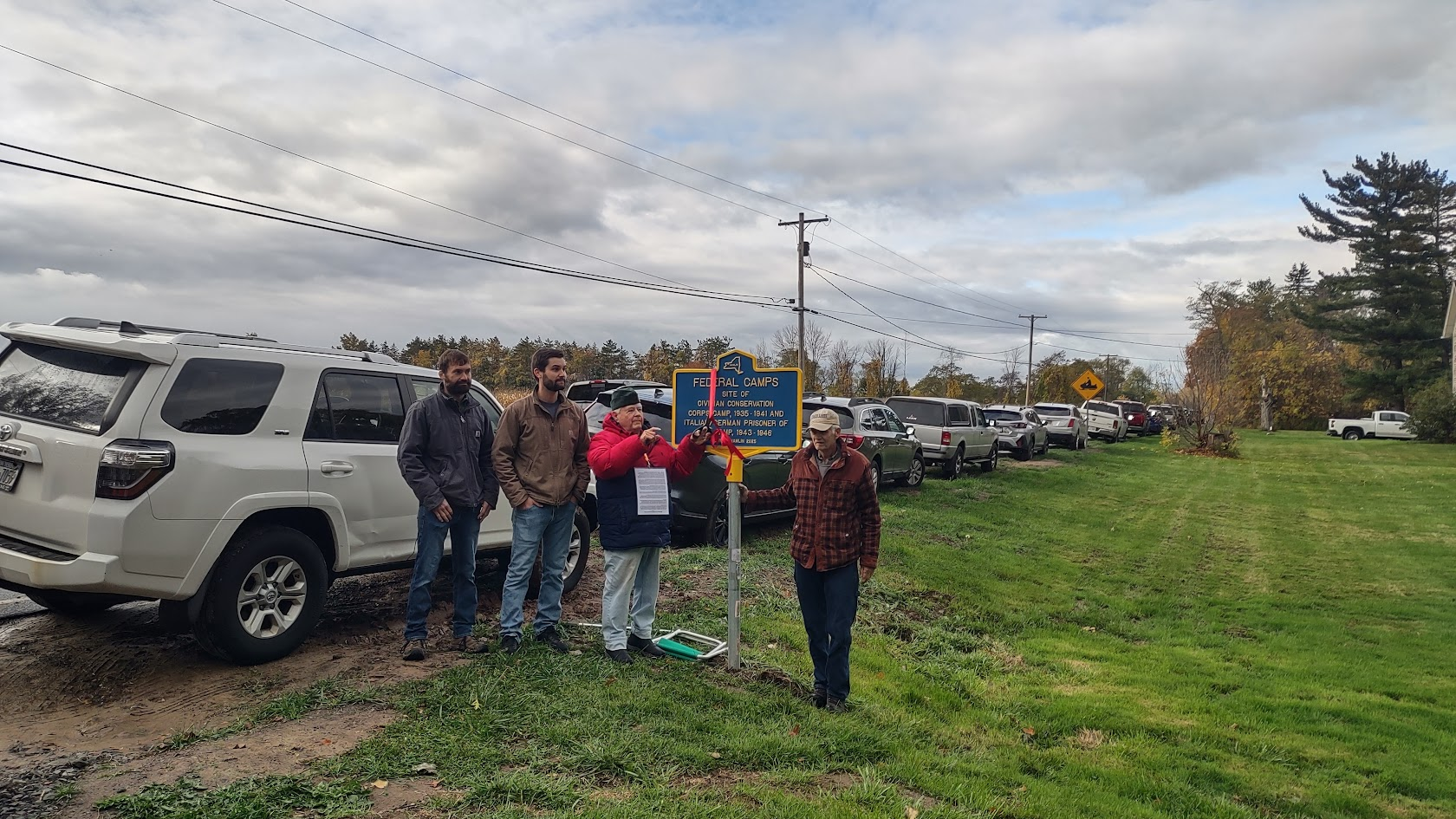
Josh and Zach Vogt, Eagle Scouts that helped in the unburying of the camp, Ed Evans, and Nick Kramer, another active volunteer in the unburying at the marker dedication on Moscow Road in Hamlin, NY.
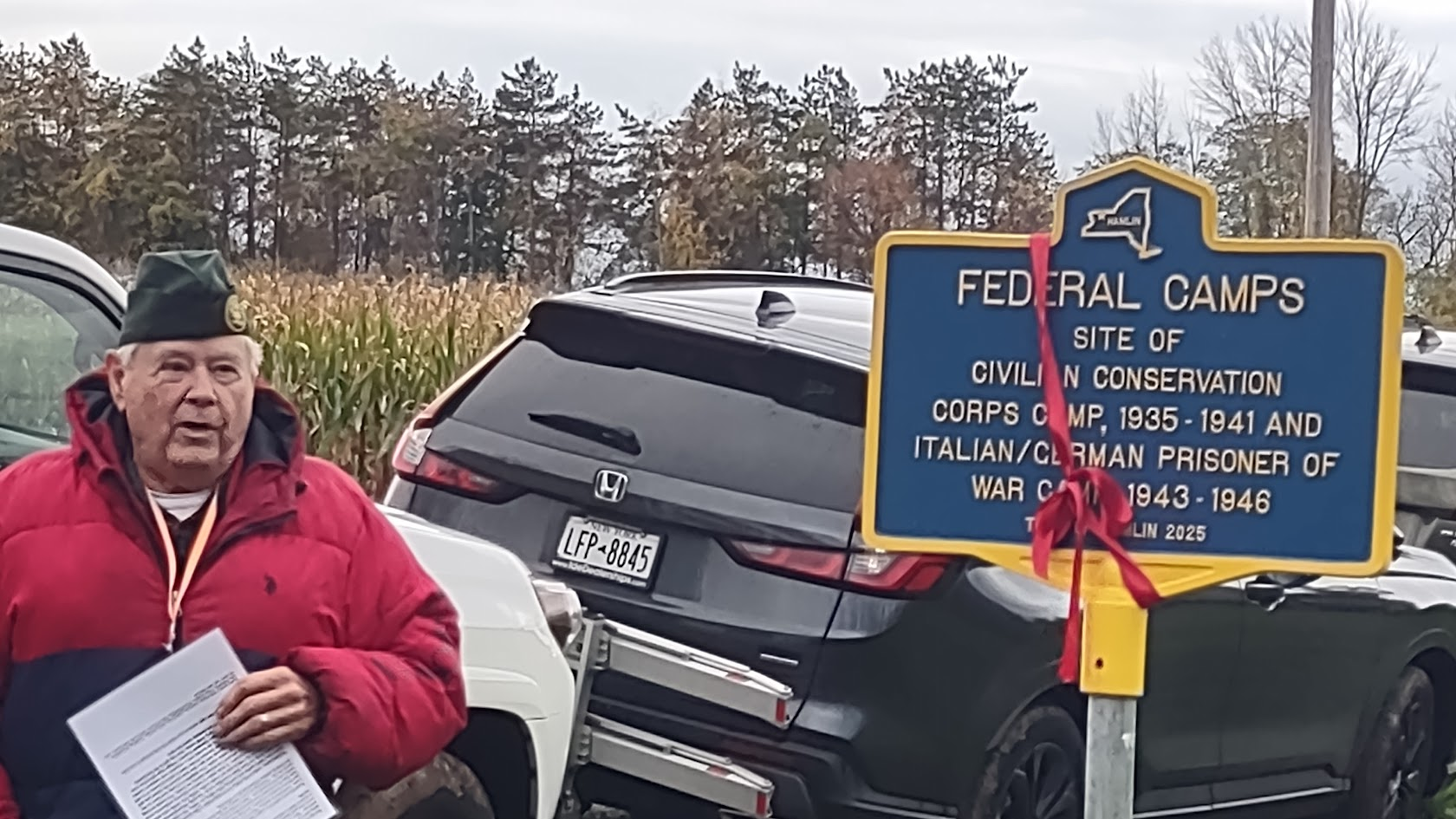
Ed Evans at the dedication of the Federal Camps marker October 25, 2025.
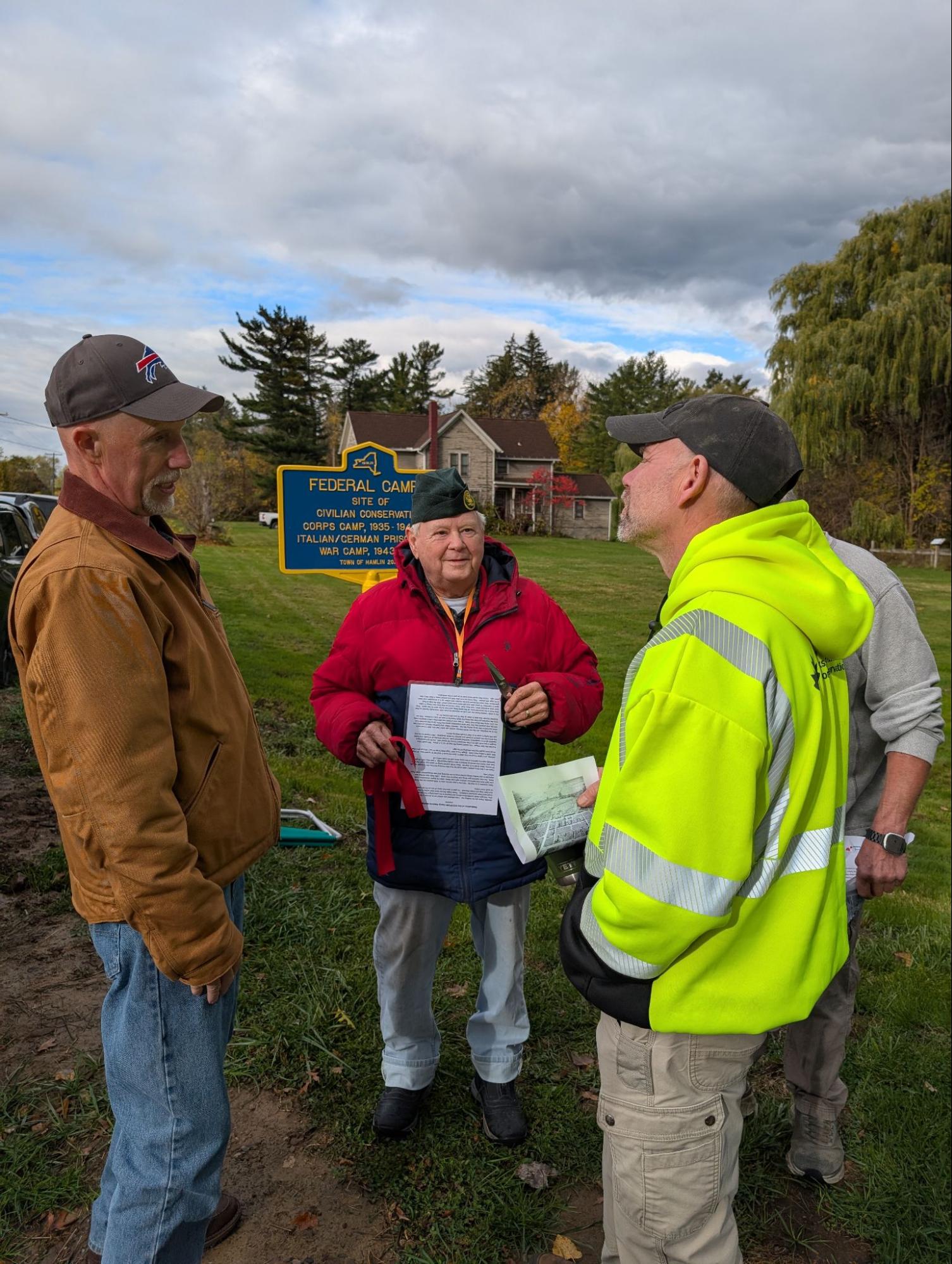
Ed Evans with Marty Howden and Jay Bailey, park managers at the start of the unburying and at the time of the historic marker dedication, at the historic marker dedication. The farmhouse in the background has a close connection with both the CCC and POW camps and is next to the camp at 968 Moscow Road.