
H Early Farming and Farm Families in the Town of Sweden
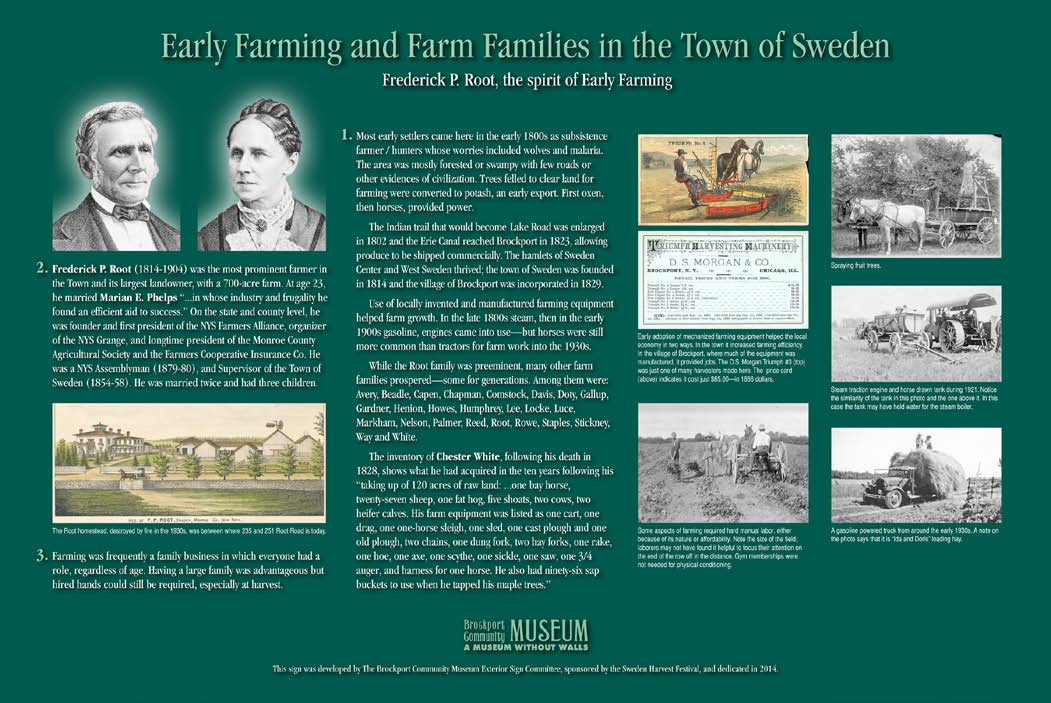
This panel is the eighth placed by the Museum. It was funded by the Town of Sweden Harvest Festival, and dedicated September 20, 2014.
Most early settlers came here in the early 1800s as subsistence farmer/hunters whose worries included wolves and malaria. The area was mostly forested or swampy with few roads or other evidences of civilization. Trees felled to clear land for farming were converted to potash, an early export. First oxen, then horses, provided power.
The Indian trail that would become Lake Road was enlarged in 1802 and the Erie Canal reached Brockport in 1823, allowing produce to be shipped commercially. The hamlets of Sweden Center and West Sweden thrived, the town of Sweden was founded in 1814 and the village of Brockport was incorporated in 1829.
Use of locally invented and manufactured farming equipment helped farm growth. In the late 1800s steam, then in the early 1900s gasoline engines came into use—but horses were still more common than tractors for farm work into the 1930s.
While the Root family was preeminent, many other farm families prospered—some for generations. Among them were: Avery, Beadle, Capen, Chapman, Comstock, Davis, Doty, Gallup, Gardner, Henion, Howes, Humphrey, Lee, Locke, Luce, Markham, Nelson, Palmer, Reed, Root, Rowe, Staples, Stickney, Way and White.
Interpretive Panel Text
Early Farming and Farm Families in the Town of Sweden
Frederick P. Root, the spirit of Early Farming
- Most early settlers came here in the early 1800s as subsistence farmer/hunters whose worries included wolves and malaria. The area was mostly forested or swampy with few roads or other evidences of civilization. Trees felled to clear land for farming were converted to potash, an early export. First oxen, then horses, provided power.
The Indian trail that would become Lake Road was enlarged in 1802 and the Erie Canal reached Brockport in 1823, allowing produce to be shipped commercially. The hamlets of Sweden Center and West Sweden thrived, the town of Sweden was founded in 1814 and the village of Brockport was incorporated in 1829.
Use of locally invented and manufactured farming equipment helped farm growth. In the late 1800s steam, then in the early 1900s gasoline, engines came into use—but horses were still more common than tractors for farm work into the 1930s.
While the Root family was preeminent, many other farm families prospered—some for generations. Among them were: Avery, Beadle, Capen, Chapman, Comstock, Davis, Doty, Gallup, Gardner, Henion, Howes, Humphrey, Lee, Locke, Luce, Markham, Nelson, Palmer, Reed, Root, Rowe, Staples, Stickney, Way and White.
The inventory of Chester White, following his death in 1828, shows what he had acquired in the ten years following his “taking up of 120 acres of raw land: …one bay horse, twenty-seven sheep, one fat hog, five shoats, two cows, two heifer calves. His farm equipment was listed as one cart, one drag, one one-horse sleigh, one sled, one cast plough and one old plough, two chains, one dung fork, two hay forks, one rake, one hoe, one axe, one scythe, one sickle, one saw, one ¾ auger, and harness for one horse. He also had ninety-six sap buckets to use when he tapped his maple trees.”
- Frederick P. Root (1814-1904) was the most prominent farmer in the Town and its largest landowner, with a 700-acre farm. At age 23, he married Marian E. Phelps “…in whose industry and frugality he found an efficient aid to success.” On the state and county level, he was founder and first president of the NYS Farmers Alliance, organizer of the NYS Grange, and longtime president of the Monroe County Agricultural Society and the Farmers Cooperative Insurance Co. He was a NYS Assemblyman (1879-80), and Supervisor of the Town of Sweden (1854-58). He was married twice and had three children.
- Farming was frequently a family business in which everyone had a role, regardless of age. Having a large family was advantageous but hired hands could still be required, especially at harvest.
Picture caption: The Root homestead, destroyed by fire in the 1800s, was between where 235 and 251 Root Road is today.
Picture caption: Early adoption of mechanical farming equipment helped the local economy in two ways. In the town it increased farming efficiency. In the village of Brockport, where much of the equipment was manufactured, it provided jobs. The D.S. Morgan Triumph #3 (top) was just one of many harvesters made here. The price card (above) indicates it cost just $85.00—in 1835 dollars.
Picture caption: Some aspects of farming required hard manual labor, either because of its nature or affordability. Notice the size of the field. Laborers may not have found it helpful to focus their attention on the end of the row off in the distance. Gym memberships were not needed for physical conditioning.
Picture caption: Spraying fruit trees.
Picture caption: Sears tractor engine and horse drawn tank during 1921. Notice the similarity of the tank in this photo and the one above it. In this case the tank may have held water for the steam boiler.
Picture caption: A gasoline powered truck from around the early 1900s. A note on the photo says that it is “Ida and Doug” loading hay.
Brockport Community Museum
A Museum Without Walls
This sign was developed by the Brockport Community Museum Exterior Sign Committee, sponsored by the Sweden Harvest Festival, and dedicated in 2014.
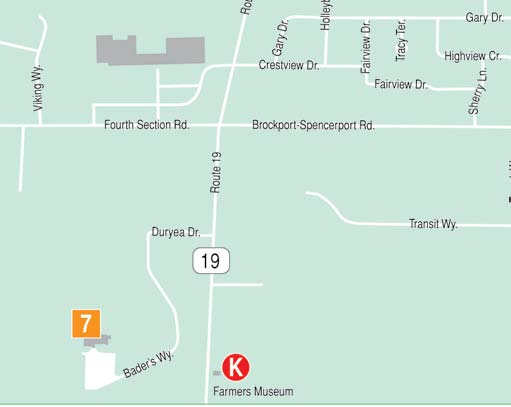
This panel is located behind the Town of Sweden Farmers Museum.
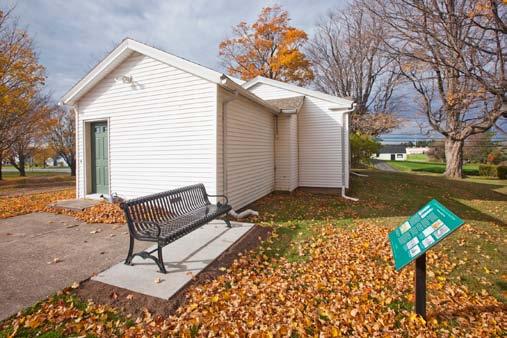
This view faces west toward Lake Road, Rt. 19.