
nm A The Canalway Trail: Brockport and Lift Bridges

This non-museum panel was developed by William G. Andrews, funded by the New York State Canal Corporation, and installed in 2003.
This non-museum panel was developed by William G. Andrews, funded by the New York State Canal Corporation, and installed in 2003
There are two interpretive panels under a kiosk on the north side of the canal just west of the Main Street lift bridge. One side is about The Canalway Trail: Brockport and includes a map of the trail that includes Brockport, Safety Tips, and Hours and Contact Information. The other side is about the Lift Bridges. There are 16 locations in western New York where lift bridges carry road and pedestrian traffic across the widened canal that were built between 1905 and 1918 and are still in operation today.
Interpretive Panel Text: The Canalway Trail: Brockport
Welcome to the Canalway Trail System, offering hundreds of miles of scenic trails and numerous parks for walking, bicycling, cross-country skiing and other recreational activities. The Canalway Trail parallels the New York State Canal System, comprised of four historic water ways: the Erie, the Champlain, the Oswego and the Cayuga-Seneca Canals. The Canal System spans 524 miles across New York State, linking the Hudson River with Lake Champlain, Lake Ontario, the Finger Lakes, the Niagara River and Lake Erie.
Cooperative initiatives between the New York State Canal Corporation, volunteers, local governments, and federal and state agencies have created this great network of trails for public use. When completed, the Canalway Trail will span over 500 miles connecting numerous cities, towns and villages along the Canal System, making it one of the most extensive trail networks in the country.
Enjoying the Canalway trail: Safety Tips
The Canalway Trail is intended to accommodate a variety of users. It is important to extend courtesy to all trail users and respect their rights. In order to avoid conflicts, trail protocol dictates that bicyclists should yield the right-of-way to all trail users and walkers should yield to equestrians. In addition, please observe the following tips for safe trail use.
- Stay to the right except when passing.
- Pass slower traffic on the left; yield to oncoming traffic when passing.
- Give a clear warning signal before passing.
- Keep pets on a short leash.
- As a courtesy to trail neighbors, refrain from loitering near houses.
- Do not litter. Carry out what you carry in.
- When stopped, move over to let others pass.
- Use extreme caution when wet or during snow/ice conditions.
Hours of Operation:
The Trail is Open from Dawn to Dusk.
To Report an Emergency call 911
For More Information about the Canalway Trail or the NYS Canal System
Please call: 1-800-4 Canals 4 or Visit Us Online at https://www.canals.ny.gov/
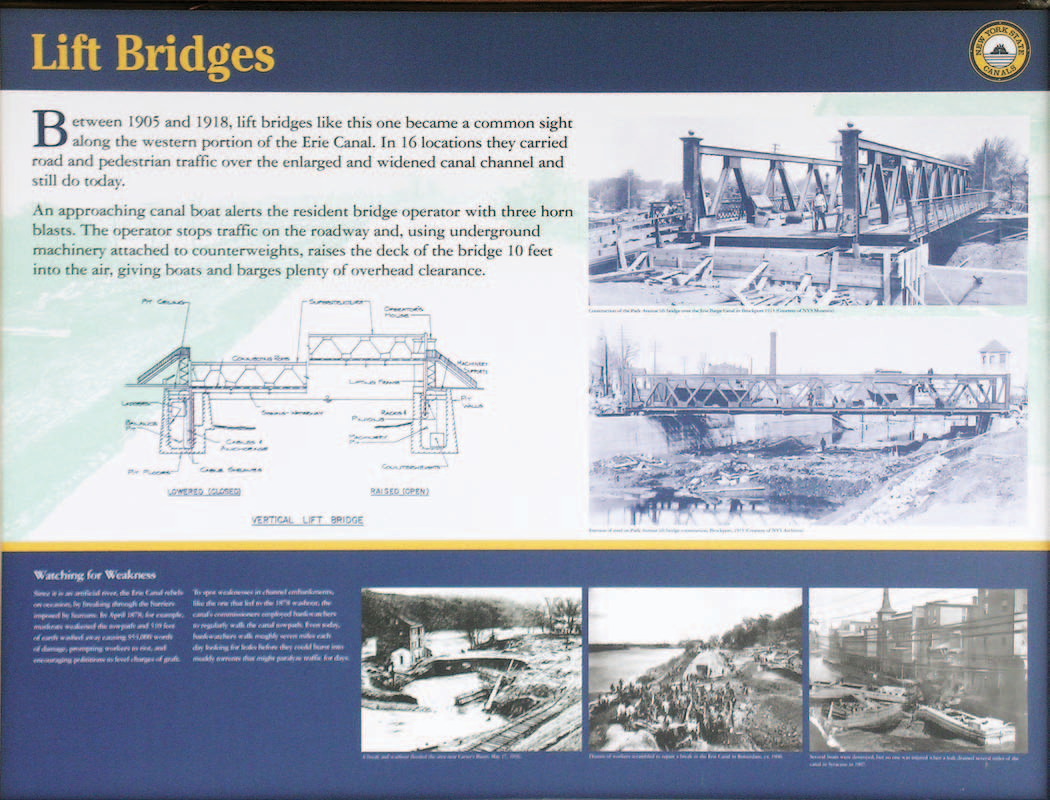
Interpretive Panel Text: Lift Bridges
Between 1905 and 1918, lift bridges like this one became a common sight along the western portion of the Erie Canal. In 16 locations they carried road and pedestrian traffic over the enlarged and widened canal channel and still do today.
An approaching canal boat alerts the resident bridge operator with three horn blasts. The operator stops traffic on the roadway and, using underground machinery attached to counterweights, raises the deck of the bridge 10 feet into the air, giving boats and barges plenty of overhead clearance.
Watching for Weakness
Since it is an artificial river, the Erie Canal, the Erie Canal rebels on occasion, by breaking through the barriers imposed by humans. In April 1878, for example, muskrats weakened the towpath and 510 feet of earth washing away causing $53,000 worth of damage, prompting workers to riot, and encouraging politicians to level charges of graft.
To spot weaknesses in channel embankments, like the one that led to the 1878 washout, the canal’s commissioners employed bankwatchers to regularly walk the canal towpath. Even today, bankwatchers walk roughly seven miles each day looking for leaks before they could burst into muddy torrents that might paralyze traffic for days.
Picture Caption: Vertical Lift Bridge (drawing)
Picture Caption: Construction of the Park Avenue lift bridge over the Erie Barge Canal in Brockport 1913 (Courtesy of NYS Museum).
Picture Caption: Erection of steel on Park Avenue lift bridge construction, Brockport, 1913 (Courtesy of NYS Archives).
Picture Caption: A break and washout flooded the area near Carter’s Basin, May 17, 1916.
Picture Caption: Dozens of workers scrambled to repair a break in the Erie Canal in Rotterdam, ca. 1900.
Picture Caption: Several boats were destroyed, but no one was injured when a leak drained several miles of the canal in Syracuse in 1907.
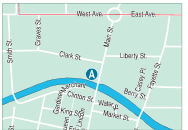
This panel is located on the north bank of the canal, just west of the Main Street bridge, here indicated by “A” in a blue circle.
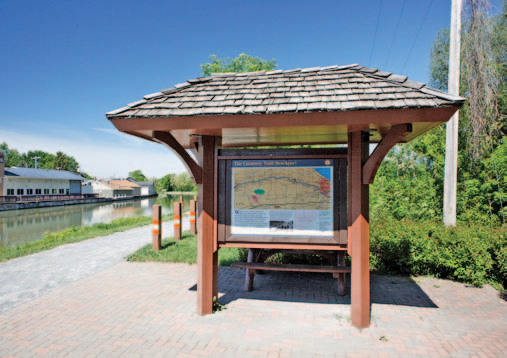
You are looking west in this view. The kiosk is two-sided. See next picture for the reverse side.
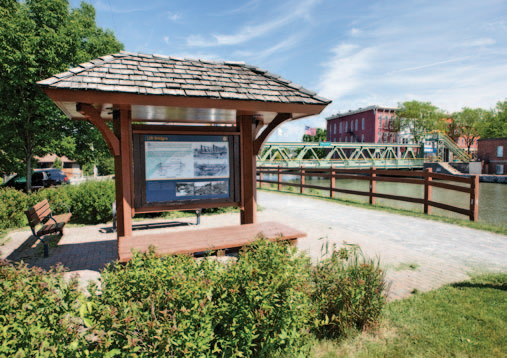
You are looking east in this view.